HCI or Three-Tier? A Decision Tree
Five questions, four leaves, one decision. Walk the tree once and the architecture argument resolves before the procurement starts.
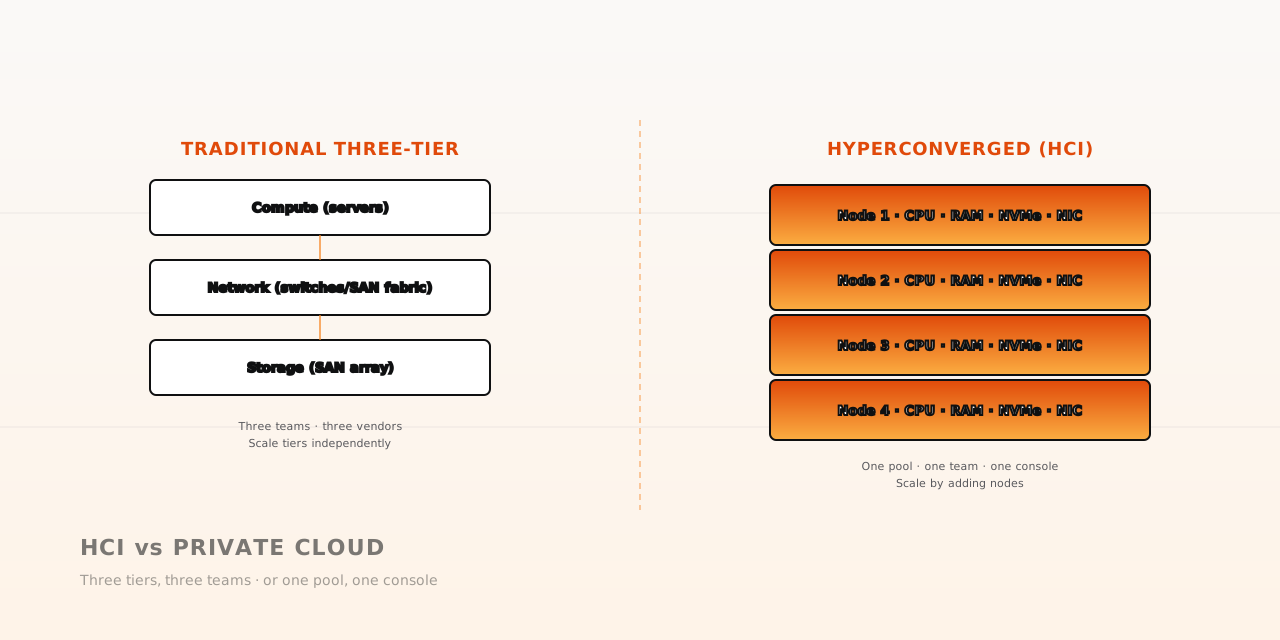
I have stopped having the which is better argument because it is the wrong question. The right question is which one fits the operating model and workload mix you actually have. Below is the decision tree I hand to architects who walk into the meeting expecting a recommendation. It returns one in five questions. The conversation that follows is usually shorter than the conversation that preceded it; the tree’s value is not that it produces a brilliant answer, but that it produces a defensible one quickly.
The grid the tree maps onto
Walk the tree
1. Do you have specialist storage and network teams already running? Yes → branch toward three-tier. No → branch toward HCI. The reason is operational economics: a specialist team is expensive to staff and expensive to lose, and a three-tier architecture justifies the cost. An HCI estate operated by a small team becomes a three-tier estate with extra steps and triple the operational complexity.
2. Are your workloads heterogeneous (databases + analytics + VDI + core systems)? Yes → strengthens three-tier. No → strengthens HCI. Heterogeneous workloads have heterogeneous storage performance profiles — a high-IOPS transactional database wants very different media than a sequential-read analytics workload. A three-tier SAN can present multiple QoS classes; HCI’s distributed storage layer scales linearly but does not segment workload classes as cleanly.
3. Is your refresh cycle staggered across compute, network, and storage? Yes → three-tier preserves the rhythm. No → HCI fits the buy-as-you-grow CAPEX shape better. Refresh discipline is under-discussed and over-consequential. A three-tier refresh moves on the cycle of each tier independently, which suits estates with mature capital planning. HCI refreshes one node at a time, which suits estates where capital is approved in smaller increments.
4. Does your audit story (BB ICT, etc.) already reference the existing SAN architecture? Yes → switching costs are real; bias toward three-tier. No → HCI’s audit story is mature enough. The audit story matters more than most architects acknowledge. A bank with a five-year history of vSphere + SAN audits has thousands of pages of documentation that a regulator has already accepted; rewriting that documentation for an HCI architecture is a year-long project on its own.
5. Is the platform team smaller than fifteen engineers? Yes → HCI’s single-pane operating model is decisive. No → either can work; weight the previous answers. Team size is the single best leading indicator of which architecture will be operationally sustainable; small teams and HCI go together in the same way large teams and three-tier go together.
What you actually trade off
| Three-tier | HCI | |
|---|---|---|
| Operational team count | 3+ specialists | 1 platform team |
| CAPEX shape | Tier-by-tier | Node-by-node |
| Storage performance ceiling | High (dedicated array) | Good, scales with nodes |
| Heterogeneous workloads | Best fit | Workable |
| Time to stand up | Months | Weeks |
| BB ICT audit story | Mature, well-trodden | Maturing, well-supported |
| Vendor lock-in shape | Per tier | Per HCI stack |
What changed after Broadcom
The pricing math shifted. vSAN inside VVF and VCF makes vSphere-based HCI economically different than it was in 2023. KVM-based HCI — Nutanix AHV, Proxmox + Ceph, StarlingX — is now a credible production option. The gap between HCI and three-tier is narrower than the gap between vSphere and KVM management planes. Pick the operating model first; the storage architecture follows.
The conversation that should not happen
Three meetings happen too often. The first is “let’s standardise on HCI everywhere” — because someone read a vendor brochure. The second is “let’s keep three-tier forever” — because someone is afraid of the consolidation. The third is “let’s run both” — because the committee could not pick. The first leads to a Tier-1 estate with HCI performance ceilings biting on month nine. The second leads to a small estate paying for specialist teams it cannot keep. The third leads to double everything for two years and then the same decision again.
What good looks like at year three
A three-tier estate that has stayed three-tier for the right reasons has, by year three: documented audit-grade evidence for the SAN, a storage team that ships infrastructure-as-code, and an architecture review board that says no to HCI proposals on cost grounds. An HCI estate that has stayed HCI for the right reasons has: a single platform team operating with three FTEs, a node-by-node refresh rhythm that finance understands, and a CMDB that nobody questions. Both are good outcomes. The wrong outcome is the estate that kept neither commitment.
Read next
- Infrastructure
Anatomy of a Hypervisor
Open the cover and look at what the hypervisor actually does — instruction trapping, shadow page tables, paravirt drivers, and the small modern miracles that make a VM feel like a host.
- Cloud Strategy
A Letter on the Bangladesh Cloud Economy
Annual letter to the Cloud Digit board on the shape, drivers, and trajectory of the Bangladeshi cloud market. Written in the long-form-thesis style that serious investors actually read.
- Cloud Strategy
The Cloud Operating Model, on a 2×2
Where you sit on the platform-control × cost-ownership grid is the single best predictor of whether your cloud programme reduces redundancy or multiplies it.