A Letter on the Bangladesh Cloud Economy
Annual letter to the Cloud Digit board on the shape, drivers, and trajectory of the Bangladeshi cloud market. Written in the long-form-thesis style that serious investors actually read.
To the Cloud Digit board —
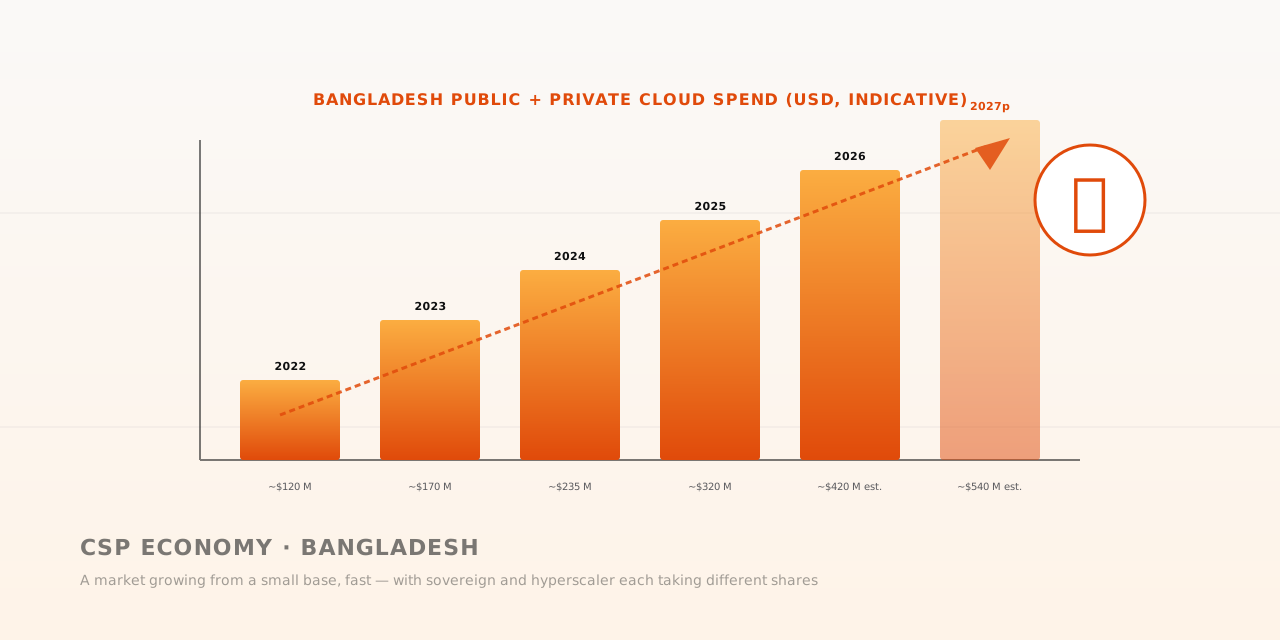
This is the working version of the cloud-economy letter I will send out formally next quarter. The framing has not yet had the lawyers’ pen, but the numbers are stable. The thesis: Bangladesh is in year three of a twenty-year sovereign-cloud build cycle, and the trajectory is the most consequential in South Asia outside India. The intent of this letter is to give the board a single document that explains why the addressable market is larger than its current revenue, why the structural moats are durable, and where the management team intends to invest the next round of capital.
The thesis, in three sentences
Three demand pillars compound — digital banking, digital government, and locally incorporated SaaS — against a regulatory frame that increasingly favours in-country deployment. Hyperscalers will keep winning frontier ML and global-SaaS workloads; sovereign providers will keep winning regulated and BDIX-sensitive workloads. Both businesses can be materially larger than they are today.
What is driving the demand curve
The first pillar is digital banking and FinTech. Bangladesh Bank’s licensing of digital-only banks, the bKash and Nagad payment ecosystem, and the regulatory push for cardless transactions have all created sustained workloads with strict residency posture. BFSI consistently accounts for roughly a third of cloud spend in our market view. The second pillar is digital government — the a2i programme, the Smart Bangladesh agenda, and ministry-level digitisation are net new spend, much of it BDT-denominated and procurement-led. The third pillar is SaaS and digital-native business — a growing population of locally incorporated software businesses serving domestic and regional customers, mostly cost-sensitive and price-disciplined. None of the three pillars is dependent on the others; each is independently durable.
The drivers, weighted
Source: Cloud Digit market view; indicative.
Where local providers actually take share
The market layers
BFSI customer data · government records · health records · BDT-priced, BTRC-licensed
Telco OSS/BSS · payment switches · BDIX-peered customer-facing platforms
Frontier ML APIs · global SaaS · CDN · DR for non-regulated workloads
Core banking · OSS core network functions · still bare-metal in many cases
The economic dynamics nobody else describes well
Two structural features of the market deserve naming. First, BDT-denominated billing creates a durable margin moat during USD- strong periods. When the BDT moves four to six percent against the dollar in a quarter — which it does, regularly — every USD-priced hyperscaler invoice repriced overnight while the local provider’s invoice did not. Customers feel this immediately. The flip side is that the local provider’s CAPEX for refresh cycles is often financed in USD, and the local provider absorbs the FX volatility inside its own P&L rather than passing it to the customer. Second, the regulated workload share is sticky in a way the unregulated workload share is not. Once a bank’s customer data is in a sovereign cloud, the cost of moving it out — both in audit overhead and in operational risk — is high enough that the provider relationship usually outlasts individual leadership changes on either side.
Risks, named honestly
The thesis depends on three assumptions that could move. Regulatory trajectory — continued sectoral guidance from BTRC and Bangladesh Bank that prefers in-country deployment. FX environment — continued USD-strength making hyperscaler invoices structurally expensive. Talent supply — continued growth of locally trained cloud and security engineers. None of these is guaranteed; all three are currently moving in the right direction. A material reversal in any one would change the trajectory but not the absolute direction; a reversal in two simultaneously would force a strategic rethink.
How we intend to deploy capital
Three priorities for the next eighteen months. First, capacity expansion in the Chattogram and Sylhet facilities to support the increasingly geographic distribution of customer-facing latency requirements. Second, vertical depth in BFSI and government — the operational and compliance specialisation that newer entrants cannot replicate quickly. Third, a private AI cloud build that captures the regulated AI workload share before the hyperscalers’ Bangladesh strategy fully arrives. Each of these is independently funded; the combination is the bet.
Why the rounding matters
Bangladesh’s cloud market is small in absolute USD terms compared to its regional peers, but the growth shape is among the most consequential in South Asia outside India. The investment thesis is not that the market will be huge; it is that the regulated workload share will be durably won by local providers, and that the infrastructure-level economics — Tier-III facilities, BDIX peering, BDT contracting — will compound over the cycle.
Read next
- Telecom
A Walk Through the Telco Network — From Tower to Public Cloud
Stand at a BTS shelter and walk inward. Each tier you pass is a different cloud decision, with its own physics, economics, and regulator.
- Cloud Strategy
Five Truths About Building a Sovereign Cloud in Bangladesh
Hard-won lessons from the field — what every newcomer underestimates about the licensing, the customer, the currency, and the country.
- Cloud Strategy
The Cloud Operating Model, on a 2×2
Where you sit on the platform-control × cost-ownership grid is the single best predictor of whether your cloud programme reduces redundancy or multiplies it.