Broadcom × VMware — Postmortem of a $61 Billion Reset
The acquisition closed; the SKUs collapsed; the pricing reset. A chronological postmortem of what happened, what changed, and what the customers I work with actually did about it.
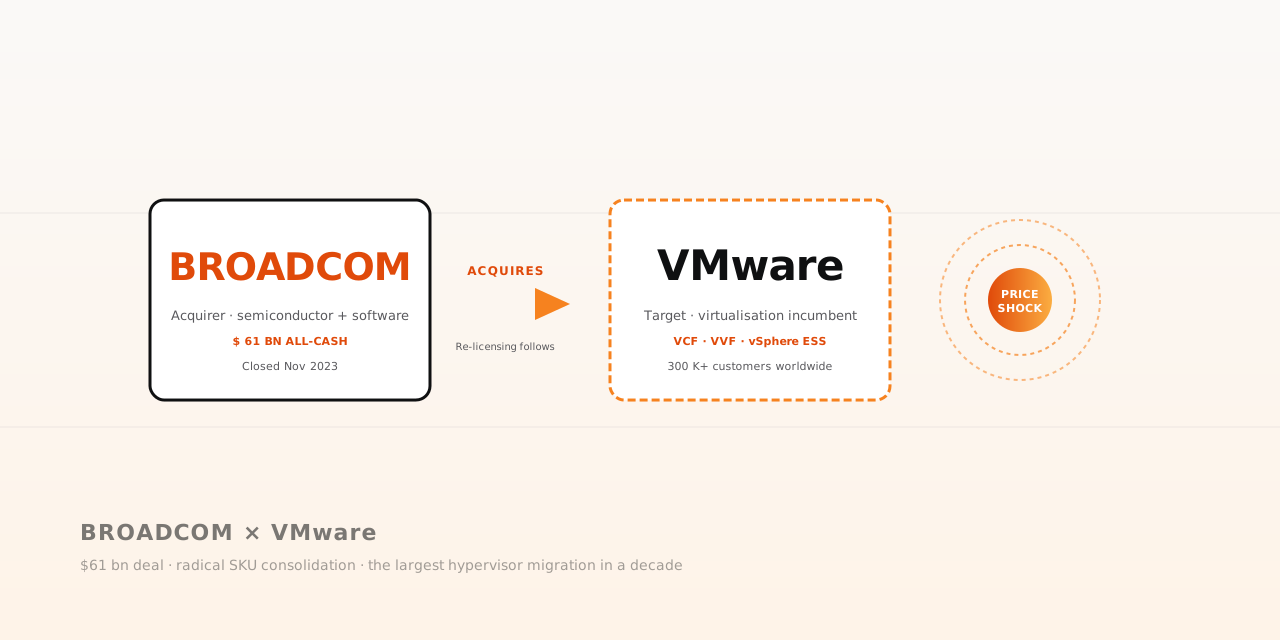
The deal closed in November 2023. The SKU consolidation happened in weeks. The customer reaction took eighteen months and is still landing. This postmortem treats the Broadcom-VMware acquisition the way a market analyst treats a regime change in a regulated industry — chronologically, unsentimentally, and with the receipts. Bangladeshi customers were not spared the broader market reset; if anything, they felt it harder because the BDT-denominated procurement environment did not absorb the USD-priced increases as easily as larger Western estates.
What happened, in order
- May 2022Broadcom announces intent to acquire VMware$61 BN all-cash; antitrust review begins across multiple jurisdictions.
- Nov 2023Deal closesAntitrust clears in the EU, US, China, and others; Broadcom takes operational control.
- Dec 2023SKU catalogue collapsed to four bundlesvSphere ESS, vVF, VCF, and a tail; standalone products discontinued.
- Feb 2024Channel rationalisation announcedMany smaller resellers lose VMware partner status; large global SIs prioritised.
- Mid-2024Pricing changes hit large enterprise renewalsPer-core subscription, 16-core minimum per CPU; perpetual licences end renewal.
- Late 2024Customer migration evaluations begin in earnestProxmox, KVM, Hyper-V, Nutanix AHV all see materially elevated evaluation traffic.
- 2025First wave of strategic re-platforming completesMost early movers are mid-size; large estates renew on revised terms with multi-year stability.
Source: Public filings + Cloud Digit customer composite, 2022–2025.
What customers reported
Source: Cloud Digit customer survey + public industry reports, 2024–2025.
“Our renewal quote tripled. The migration estimate was three years. The optimisation we hadn’t done in five years bridged the gap. Without that slack we were stuck.”
Four observed responses
Most customers renewed but renegotiated harder than they ever had, trading a higher unit price for multi-year predictability. A second group did tactical migrations of low-criticality workloads — dev/test, edge sites, lab environments — to KVM-based stacks, reducing the licensed core count without disturbing production. A third, smaller group committed to strategic re-platforming, picking Proxmox + Ceph or Nutanix AHV as the new default. A fourth, niche, group lifted-and- shifted to public cloud where economics genuinely fit. The choice between these paths usually came down to the size of the estate, the maturity of the platform team, and the customer’s tolerance for operational change during a procurement cycle.
The hidden second-order effects
The licensing change is the headline. The second-order effects matter more — and most CFO models missed them. Disaster-recovery posture, backup tooling, and the operational training pipeline all rested on VMware as a constant; when the constant moved, all three had to be re-priced or re-skilled. The DR products tied to VMware’s SRM became either more expensive (in the new bundle) or strategically obsolete (if the customer was migrating away). The backup ecosystem had to reissue licences to match the new core counts. And the operational training pipeline — the year-on-year investment in vSphere-certified admins — became a strategic question for the first time in two decades.
What changed for Bangladeshi customers specifically
Three regional consequences deserve naming. First, smaller resellers lost VMware partner status, which moved many local enterprises into the orbit of large global SIs that did not previously serve them well; the relationship management deteriorated before it improved. Second, the BDT/USD exposure on subscription pricing became a material P&L variable, and several customers requested BDT-denominated multi-year contracts that reseller channels were not prepared to write. Third, KVM-based alternatives matured into credible production options during exactly the window when Bangladeshi customers were re-evaluating, which made the migration decisions less risky than they would have been three years earlier.
What I would tell a CIO renewing this year
Three actions are defensible regardless of which response path you ultimately take. First, inventory your VMware footprint to the core: how many sockets, how many cores, which features are actually used. The answer is almost always smaller than the licensing assumes. Second, model the cost of three scenarios — renew on Broadcom terms, partial migration, full re-platform — to the same TCO horizon. Third, run a small-scale alternative pilot: Proxmox + Ceph or KVM-based HCI on a non-critical workload, just to keep the option real in negotiation.
Where the market is now
Eighteen months in, the dust is mostly settled. The largest VMware customers have signed multi-year renewals with negotiated discounts. Mid-sized customers have either picked an alternative or accepted a managed migration. Smaller customers — particularly in the Bangladeshi NBFI and SME segment — are disproportionately moving to KVM-based stacks, because the per-core minimums hit them hardest. Broadcom’s revenue from the VMware unit is up; customer satisfaction with the relationship is down; and the open-source virtualisation ecosystem has gained the most credibility it has had in a decade. Each of these outcomes was predictable from the deal terms.
Read next
- Infrastructure
Anatomy of a Hypervisor
Open the cover and look at what the hypervisor actually does — instruction trapping, shadow page tables, paravirt drivers, and the small modern miracles that make a VM feel like a host.
- BFSI
Notes from a BFSI Hybrid Migration: An Audit Diary
Eighteen months inside a Tier-1 bank moving from a single-vendor private cloud to a regulated hybrid. The notes I kept, and what they say in retrospect.
- Cloud Strategy
Five Truths About Building a Sovereign Cloud in Bangladesh
Hard-won lessons from the field — what every newcomer underestimates about the licensing, the customer, the currency, and the country.