Five Truths About Building a Sovereign Cloud in Bangladesh
Hard-won lessons from the field — what every newcomer underestimates about the licensing, the customer, the currency, and the country.
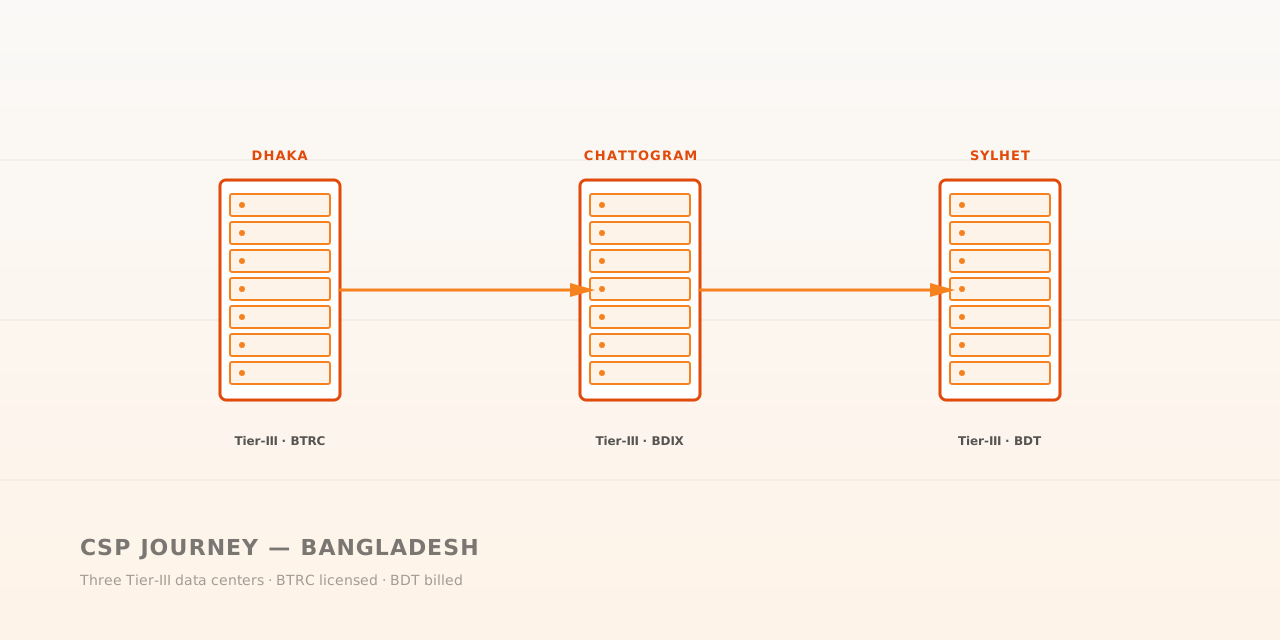
After eight years of selling, building, and explaining sovereign cloud to boards, regulators, and procurement officers in this country, the same five things still surprise people. None of them appear in the marketing deck. All of them decide whether a deal closes. The newcomers we have watched — and there have been many in the last three years — almost all underestimate exactly the same parts of the business.
Truth one: the licence is the product
The BTRC Cloud Service Provider licence is not paperwork. It is the entire moat. Tier-III certification, an in-country control plane, named key-personnel attestation, and an annual audit — these are the things a hyperscaler region cannot replicate without becoming, structurally, a different company. Underestimate the licence and you misprice the entire business. Newcomers sometimes treat it as a one-time compliance project to clear before launch; in reality it is a continuous attestation that shapes recruitment, facility planning, and even who the company hires onto its board. The institutions that buy from us know this and read the licence before they read the technical proposal. The licence is what they are actually procuring.
Truth two: nobody pays in dollars
International benchmarks assume credit-card billing. Bangladesh runs on electronic funds transfer, cheque, and letter of credit, in BDT, against yearly purchase orders. Six in ten customer invoices we issue settle by EFT. A USD invoice in this market is a friction point, not a feature. The operational consequence is severe: the entire revenue function — sales, AR, collections, dispute resolution — has to be designed around the procurement calendars of state-owned enterprises and large private banks, which do not look anything like the SaaS quarterly cadence the global cloud industry takes for granted. The provider that builds these workflows once, well, collects faster than the provider that retrofits them later, badly.
Truth three: latency is a procurement weapon
The hyperscaler region is roughly 250 milliseconds away. BDIX-peered infrastructure is under fifty. That gap looks small on a slide and feels enormous in a customer demo. We have closed deals on demo latency that were lost on price three months earlier. The reason is structural: latency- sensitive workloads — payment switches, mobile-banking apps, real-time fraud scoring — have hard SLAs that simply cannot be met from Singapore at a price that competes with BDIX-peered domestic delivery. Once procurement sees a side-by-side dashboard with ping numbers, the conversation moves from which provider is cheaper to which provider can actually serve our customers. The economics follow.
Truth four: procurement runs on calendars, not quarters
Enterprise cycles are four to nine months in this market. Public-sector cycles are longer. The instinct from hyperscaler-trained sales teams is to push for quarterly close — and they consistently miss the fiscal-year-end window where almost every meaningful contract actually closes here. We rebuilt our pipeline forecasting in year two around 4-to-9-month cycles synchronised to the customer’s procurement calendar, and started staffing contract paper from the moment a budget was approved rather than from the moment a verbal commitment was given. The conversion rate doubled. The cycle did not.
Truth five: a regulator on speed-dial is a feature
“What I get from a local provider is not faster compute. It is a director who answers the phone when BTRC asks a question, and who is in the same room as my regulator the next day.”
The hyperscaler model assumes regulators are problems to be managed at arm’s length. The local model assumes regulators are stakeholders to be served. Different muscle, same word. A licensed local provider is, by construction, jointly accountable to the customer and the regulator. That arrangement is not glamorous, but it is precisely what every BFSI compliance officer wants when their phone rings at 9 p.m. on a Sunday. Trying to replicate that posture from a global headquarters in another time zone is mathematically possible and operationally exhausting; the customers who have tried it know.
A bonus truth, learned the hard way
Strategy is the easy part. Operations are the work. The newcomers who survive year three are the ones who, by then, run a functioning network operations centre, a credible support practice in Bangla, a documented incident-response process, and an accounts-receivable team that knows how to chase a state-owned enterprise without losing the next renewal. None of those exists by default; all of them take eighteen to twenty-four months to industrialise; and customers can tell the difference within the first two support tickets.
Read next
- Cloud Strategy
A Letter on the Bangladesh Cloud Economy
Annual letter to the Cloud Digit board on the shape, drivers, and trajectory of the Bangladeshi cloud market. Written in the long-form-thesis style that serious investors actually read.
- BFSI
Notes from a BFSI Hybrid Migration: An Audit Diary
Eighteen months inside a Tier-1 bank moving from a single-vendor private cloud to a regulated hybrid. The notes I kept, and what they say in retrospect.
- Finance
The Anomaly: A FinOps Detective Story
A real cost spike, the investigation that found it, and the maturity model that emerged from the lesson. Cloud economics taught the way it actually gets learned.